
I. First, Clarifying the Fundamental Architectures
- LPO (Linear-Drive Pluggable Optics)
LPO uses a direct-drive architecture in which the transmitter laser is driven directly by the electrical Driver, while the receiver uses a linear TIA. The DSP chip is completely eliminated from the optical module.
Signal equalization, compensation, and retiming are handled entirely by the high-performance SerDes inside the switch ASIC. The primary goal is to achieve ultra-low power consumption and maximize energy efficiency.
- Hybrid Semi-DSP
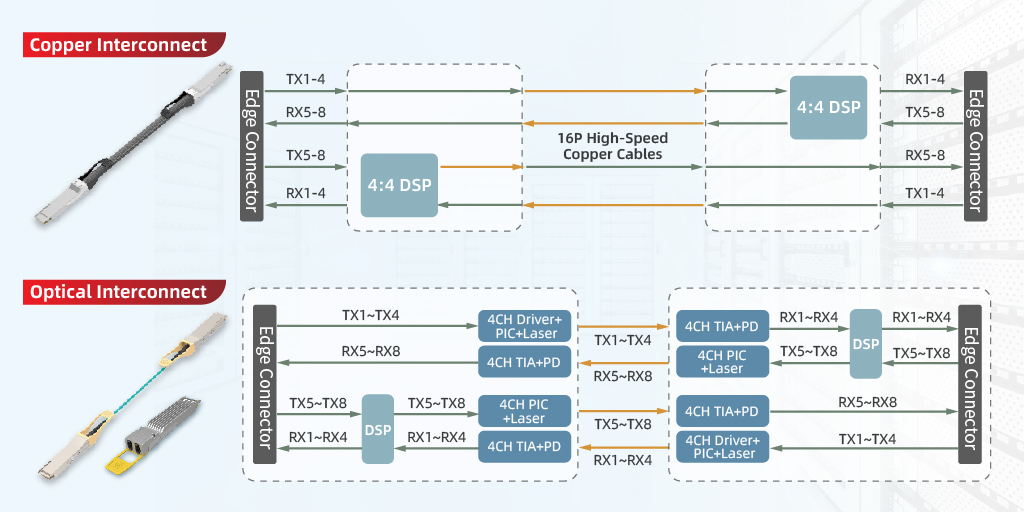
Hybrid Architecture Diagram
A Hybrid Semi-DSP solution integrates a lightweight and streamlined DSP inside the optical module, retaining basic digital equalization, signal compensation, and configurable tuning capabilities on the Tx/Rx side.
Instead of implementing the complex long-distance dispersion and nonlinear compensation algorithms of a full DSP, the Hybrid architecture strikes a balance among power consumption, performance, and controllability. It also enables open parameter tuning through a host system.
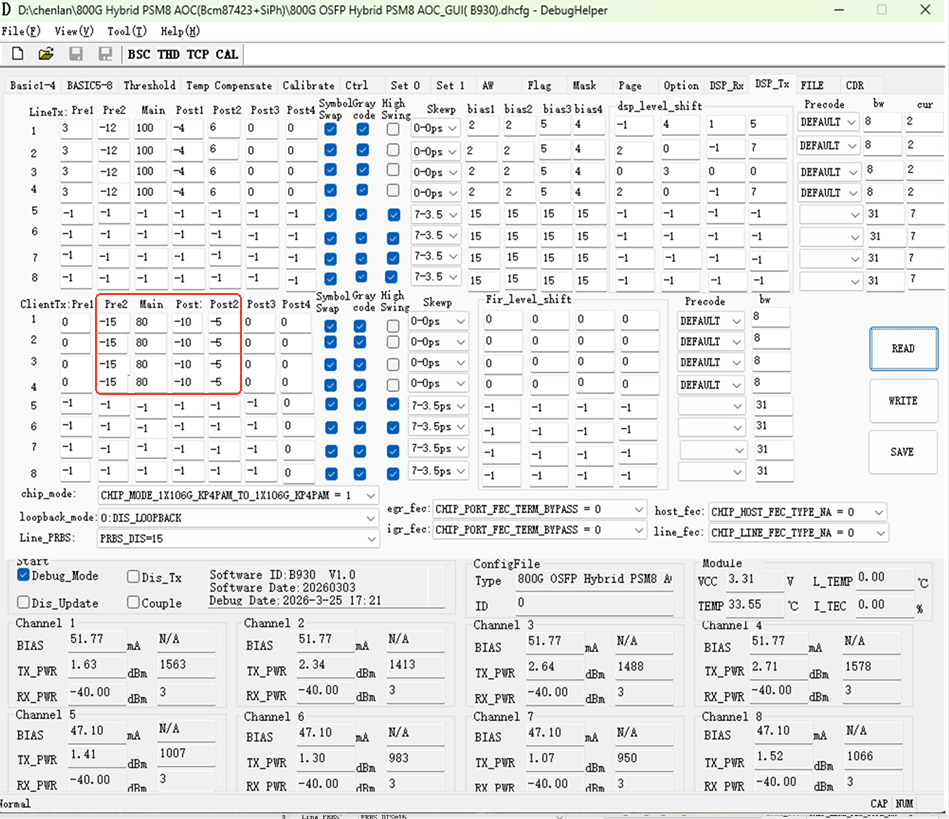
DSP-TAP Parameter Tuning via Host System
GIGALIGHT provides Hybrid optical solutions designed to combine the low-power advantages of LPO with the flexibility, link margin, diagnostics, and configurability of DSP-based optics.
II. Core Comparison from an AI Computing Networking Perspective
1. Power Consumption
LPO:
LPO has a clear advantage in power consumption. By eliminating the DSP, it removes the DSP power overhead and can achieve the lowest module power consumption. This is particularly attractive for short-reach links in high-density AI racks where reducing TCO and power consumption is a top priority.
Hybrid:
Hybrid consumes more power than LPO but significantly less than conventional full-DSP optics. Through dynamic algorithm enable/disable control, power consumption can be adjusted according to actual link conditions.
Trade-off:
LPO provides fixed ultra-low power consumption, while Hybrid provides dynamically adjustable power-performance optimization.
2. Link Margin and Transmission Distance
LPO:
Link compensation relies entirely on the switch SerDes, while the optical module itself has limited signal recovery and compensation capability. As a result, LPO can be more sensitive to fiber quality, connector cleanliness, and temperature fluctuations.
Typical applications:
In-rack and short rack-to-rack links, generally up to 100 m, particularly in newly deployed AI clusters with high-quality cabling.
As cabling ages, patching stages increase, or link distances become longer, the available link margin can decrease rapidly.
Hybrid:
The integrated lightweight DSP provides local signal recovery and compensation, offering greater link margin and stronger tolerance to link degradation.
Typical applications:
100–500 m data-center interconnects, mixed or legacy cabling environments, short- and medium-reach DCI, and upgrades of existing data centers.
3. System Dependency and Interoperability
LPO:
Because the optical module does not perform complete signal recovery, the module and switch SerDes must be jointly tuned and optimized.
Different switch vendors may have significant differences in SerDes performance and implementation, making cross-vendor interoperability and mixed-brand deployment more challenging. As a result, LPO is particularly suited to vertically integrated and highly customized AI clusters.
Hybrid:
The module performs basic signal recovery independently, retaining the plug-and-play characteristics of conventional optical transceivers.
This reduces the optical module’s dependence on a specific switch ASIC implementation and facilitates multi-vendor equipment deployment, making Hybrid more suitable for open and heterogeneous AI computing networks.
4. Operations, Monitoring, and Fault Diagnosis
LPO:
Without a DSP, LPO generally provides only basic optical monitoring such as Tx/Rx optical power. Advanced information such as eye diagrams, error statistics, and dispersion-related parameters is more limited.
When bit errors occur, it can be difficult to quickly determine whether the root cause is the fiber, optical components, connectors, or the switch. This can significantly increase troubleshooting costs in large-scale AI clusters.
Hybrid:
The lightweight DSP can retain digital diagnostics capabilities, including real-time error monitoring, signal-quality analysis, and link-degradation warnings.
This enables clearer fault isolation and is advantageous for large-scale deployments requiring sophisticated network operations and maintenance.
Hybrid solutions can also support host-side configurable equalization and tuning strategies, enabling more granular management and optimization of AI computing networks.
5. Supply Chain and Mass-Production Cost
LPO:
The simplified architecture eliminates the expensive DSP, theoretically enabling the lowest BOM cost.
However, LPO places more stringent performance requirements on optical components, lasers, and photodetectors. As data rates continue to increase, particularly toward 224G PAM4, maintaining production yield becomes increasingly challenging.
In this architecture, a significant portion of the system-level value shifts toward the switch SerDes and ASIC vendors.
Hybrid:
The use of a lightweight semi-DSP increases BOM cost compared with pure LPO.
However, the value of the solution can remain within the optical module vendor through algorithm optimization, adaptive tuning, and implementation know-how. The architecture also provides greater tolerance to optical and manufacturing variations, resulting in a wider production window.
6. Business Application Scenarios
(1) In-Rack / Very Short-Reach Connections in AI Training Clusters → LPO is More Suitable
Extremely short distances, new cabling, highly integrated architectures, and a strong focus on maximum power efficiency make LPO attractive for densely packed AI compute environments.
(2) Rack-to-Rack, POD-to-POD, Legacy Data Center Upgrades, and SMB/Enterprise AI Computing Centers → Hybrid Has Greater Advantages
More complicated cabling, longer link distances, multi-vendor equipment, and the need for network control, diagnostics, and open tuning capabilities make Hybrid a more flexible choice.
(3) Short- and Medium-Reach DCI → Hybrid
LPO can become less practical as distance and link complexity increase.
Hybrid can adapt to different fiber and link conditions through open parameter tuning, making it a potential cost-effective option for short- and medium-reach DCI applications.
III. Overall Industry Positioning
- LPO: Ultra-Low-Power Short-Reach AI Computing Solution
Key value proposition:
Ultra-low power consumption, highly customized architecture, short-reach applications, and newly deployed high-density AI clusters.
LPO achieves maximum power efficiency by trading away some link margin, interoperability, and diagnostic flexibility.
- Hybrid: Open, Configurable, and Flexible AI Computing Solution
Key value proposition:
Configurable power consumption, stronger link margin, host-side tuning, better diagnostics, multi-vendor compatibility, and support for legacy network environments.
Rather than pursuing the absolute minimum power consumption, Hybrid delivers greater flexibility, operational control, and long-term value across a wider range of AI networking scenarios.
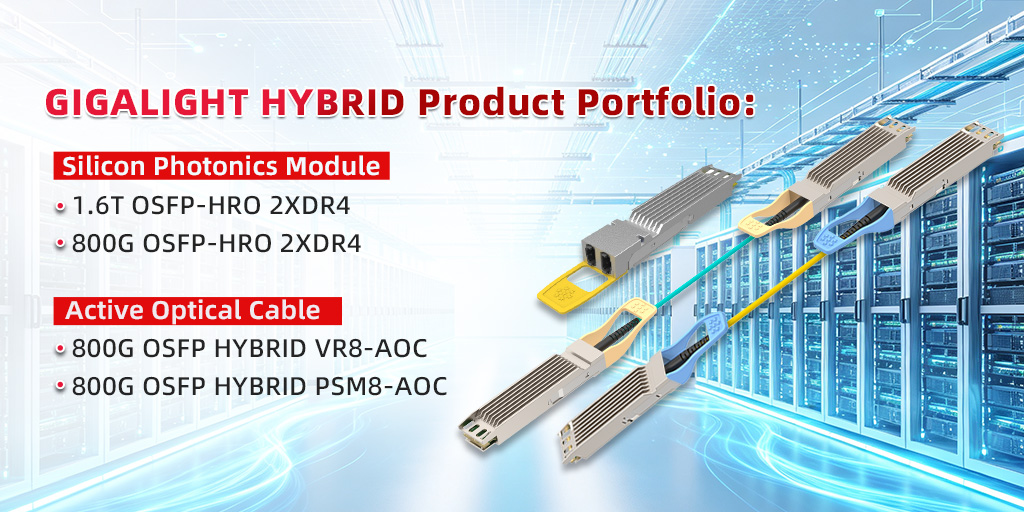
GIGALIGHT Hybrid Product Portfolio
GIGALIGHT ‘s Hybrid portfolio is positioned to bridge the gap between pure LPO and conventional full-DSP optics, providing an open and configurable architecture for next-generation AI computing networks.
IV. The Real Trend in AI Computing Networking
LPO and Hybrid are not simply replacement technologies. They are complementary architectures for different layers of the AI networking infrastructure.
At the innermost layer of the AI rack, where link distances are extremely short and power efficiency is the overriding priority, LPO can be used to minimize power consumption.
For POD-to-POD, rack-to-rack, data-center-wide, and short-/medium-reach DCI connectivity, Hybrid solutions can provide greater link margin, interoperability, diagnostics, and configuration flexibility.
Together, LPO and Hybrid can form a layered and complementary optical interconnect architecture for AI computing, balancing power efficiency, performance, deployment flexibility, and long-term network operability.