
I. Background: Layered Requirements of Computing Networks
With the deployment of large-scale AI training and inference clusters, computing interconnect networks are developing a distinct layered architecture:
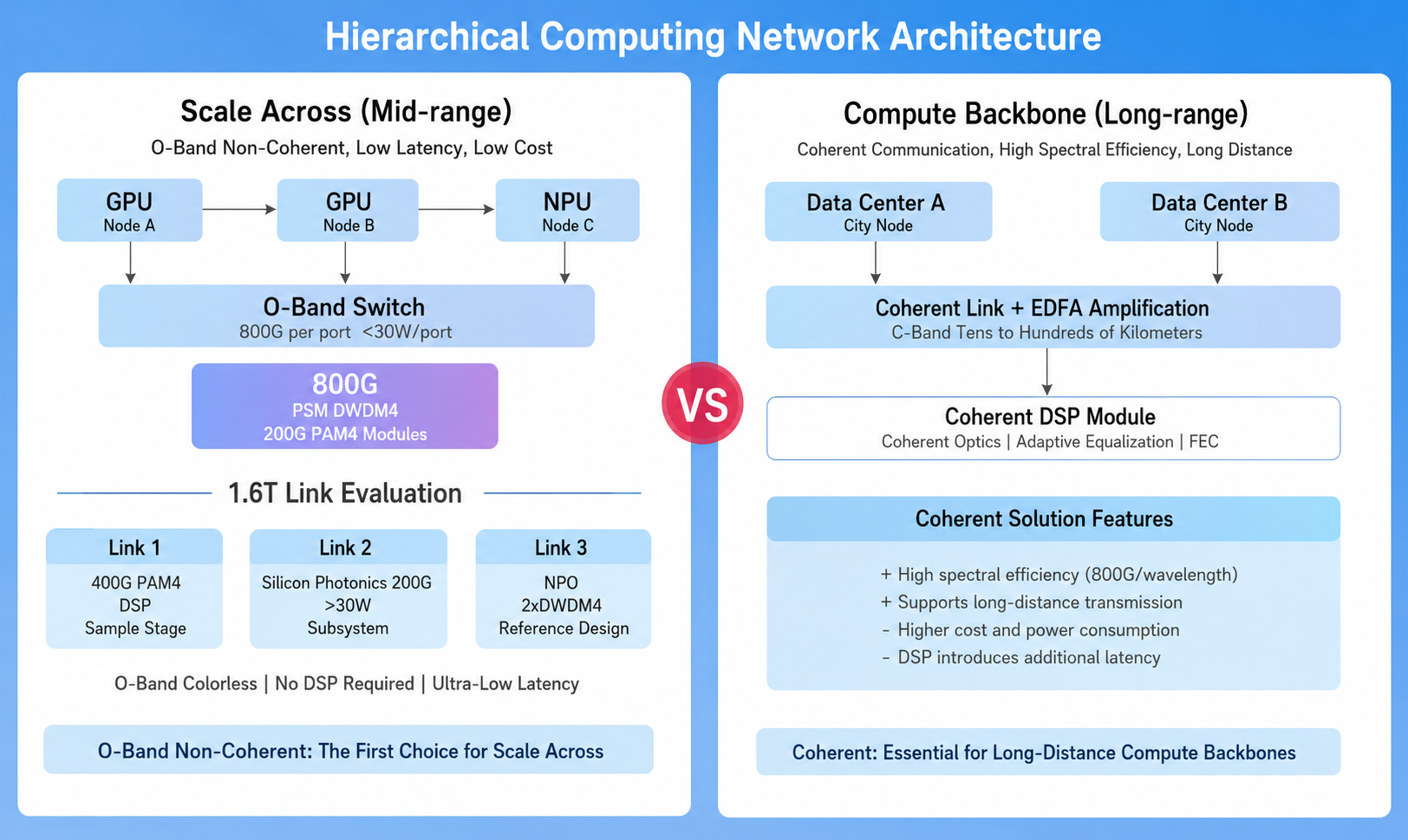
• Scale Across Network (short-to-medium range): Interconnects computing nodes between racks, cabinets, and within machine rooms, typically covering distances from hundreds of meters to a few kilometers. Latency-sensitive and extremely cost-sensitive—this is the core of today’s GPU/NPU cluster networking.
• Computing Backbone Network (long distance): Cross-datacenter, cross-city computing dispatch over tens to thousands of kilometers, requiring spectral efficiency and line amplification. Coherent communication is the indispensable technology here.
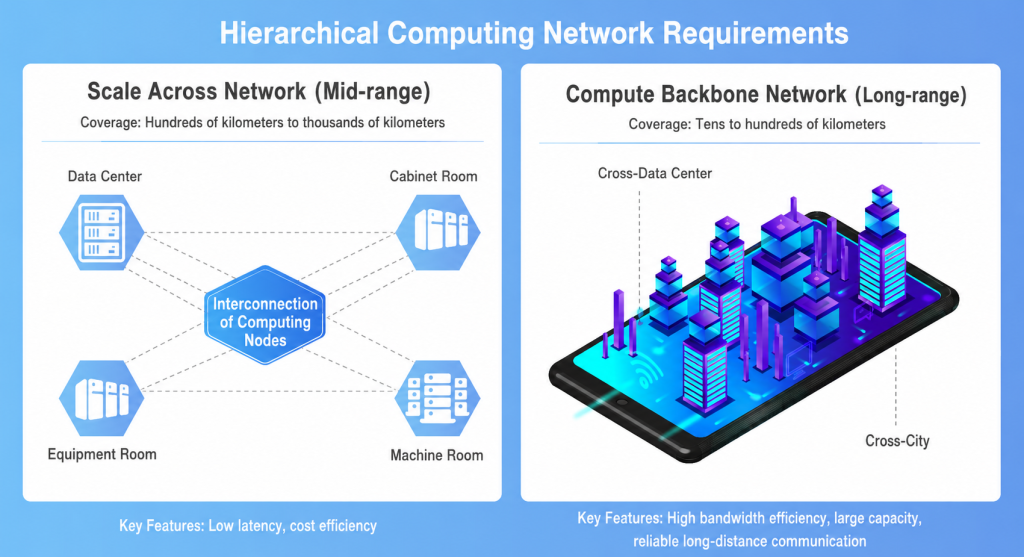
These two types of networks have fundamentally different requirements for optical modules. Long-distance computing networks must use coherent communication, whereas Scale Across short-to-medium range networks have absolutely no need for coherent solutions—the additional cost, power consumption, and latency introduced by coherent systems are purely burdensome in this scenario.
II. Why Does Scale Across Choose O-Band Incoherent Solutions?
O-Band (1260–1360 nm) offers three key advantages in short-to-medium range transmission:
• Zero-Dispersion Window: O-Band operates near the zero-dispersion point of optical fiber—no dispersion compensation is needed, signal integrity is excellent, and it accommodates high-order modulation formats like PAM4 without DSP dispersion equalization overhead.
• Low Latency: The incoherent architecture eliminates the processing delay of coherent DSP, achieving extremely low end-to-end latency—critical for collective communication operations like All-Reduce in AI training.
• Most Economical System Cost: No local oscillator laser, 90° optical hybrid, or complex DSP required; silicon photonics solutions are sufficient, and BOM cost is substantially lower than coherent solutions.
In Scale Across scenarios, O-Band incoherent solutions provide the optimal cost-latency-power triangle balance.
III. Current Product Coverage: Up to 800G Without Obstacles
The current incoherent solution based on single-wavelength 100G O-Band can fully cover up to 800G speeds. In the future, the 800G solution can be built on the proven single-channel 200G PAM4, with low technical risk and high system completeness.

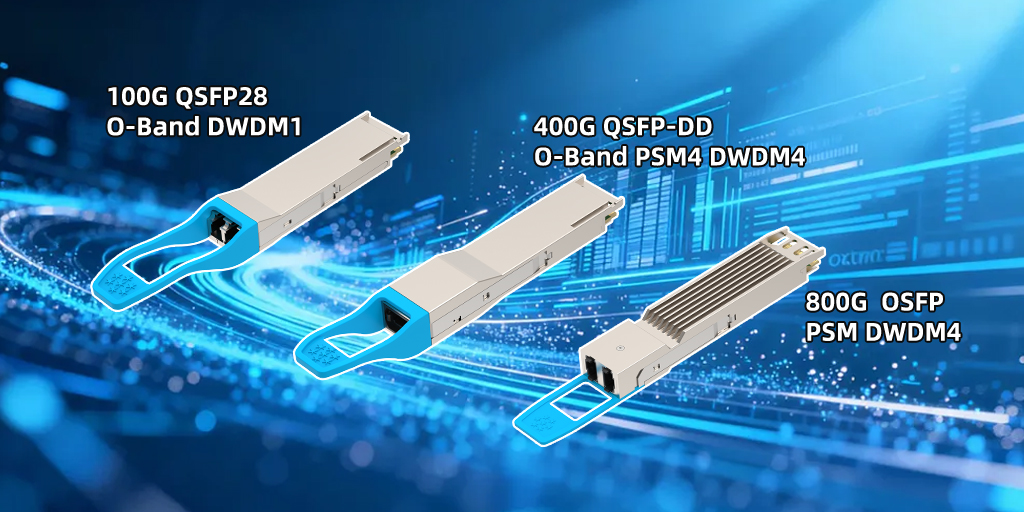
IV. 1.6T Scale Across: Evaluation of Three Technical Pathways
When evolving toward 1.6T, there are three viable pathways, each with different technology maturity and engineering constraints:
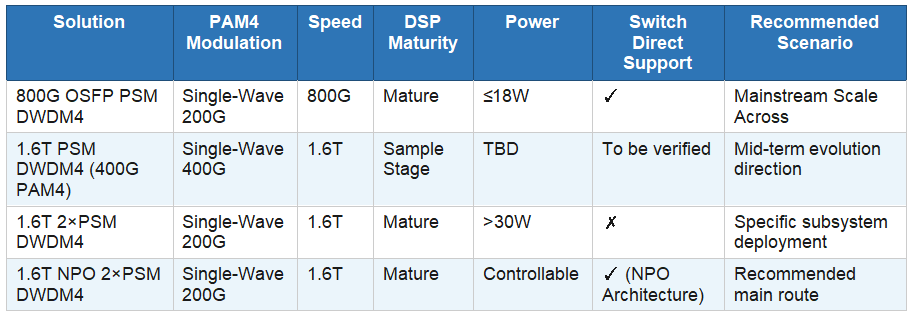
Path 1: 1.6T PSM DWDM4 (Single-Wave 400G PAM4, Silicon Photonics Modulation)
This is the most aggressive single-module solution. The DSP for single-wave 400G PAM4 has not yet entered mass production, but 1.6T DR4 samples have already appeared in the industry, indicating that 400G PAM4 DSP chip samples exist. The transition from samples to mass production will take time; this is expected to be a viable mid-term direction.
Path 2: 1.6T 2×PSM DWDM4 (Single-Wave 200G PAM4, Silicon Photonics Modulation)
Based on proven 200G PAM4 silicon photonics modulators, achieving 1.6T by stacking two 800G sub-modules. Technically feasible, but power consumption is the core bottleneck: if total power exceeds 30W, switch ports cannot directly power the module, requiring additional power supply design that breaks the plug-and-play nature of pluggable modules. This solution is only suitable for specific subsystem deployment under power constraints and is unlikely to become the mainstream Scale Across solution.
Path 3: 1.6T NPO 2×(PSM DWDM4) (Single-Wave 200G PAM4) ✓ Recommended
The NPO architecture places the optical engine near or integrated into the switch chip package, fundamentally resolving the dual challenges of power consumption and signal integrity. This is the most viable engineering path for achieving 1.6T Scale Across at the current stage.
• Extremely short electrical signal routing, significantly reducing SerDes power consumption
• No longer constrained by the power budget of standard pluggable modules
• Based on proven 2×PSM DWDM4 architecture with a clear technology path
• Can fully achieve 1.6T O-Band incoherent Scale Across
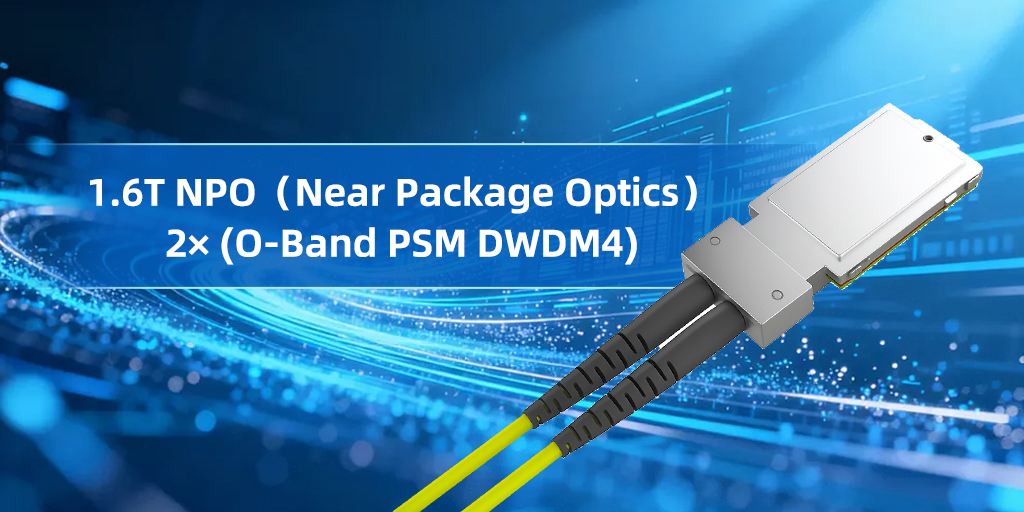
V. Technology Pathway Comparison Summary
VI. Conclusion
The fundamental requirements of Scale Across computing networks are: low latency, low cost, high density, and easy operation and maintenance. In short-to-medium range computing interconnect scenarios, the system complexity introduced by coherent communication is completely unnecessary, and O-Band incoherent solutions naturally align with these requirements.
• O-Band incoherent 400G and 800G PSM DWDM4 solutions are technically mature and ready for large-scale deployment.
• O-Band incoherent 1.6T DWDM can be achieved through design innovation.