Overview
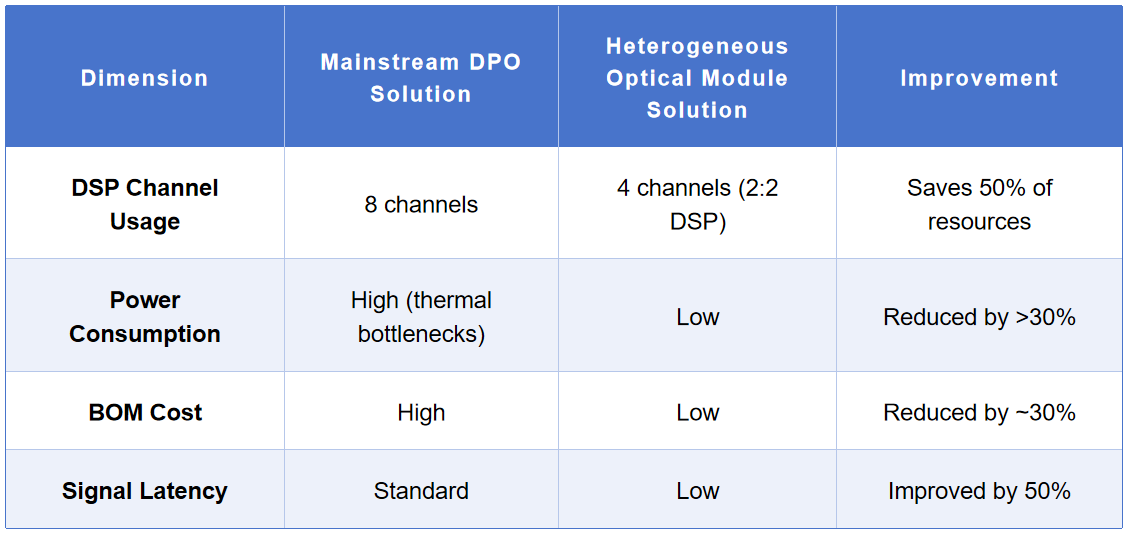
GIGALIGHT’s 1.6T OSFP224 DR8 PHO silicon photonics module employs the company’s patented Hybrid architecture technology, which can be implemented using either VCSEL-based or silicon photonics-based designs. Unlike traditional full-DSP optical modules, the HYBRID design uses only half of the DSP channels, resulting in significantly reduced power consumption and latency.
The HYBRID modules and active optical cables draw inspiration from industry-standard LPO/LRO design methodologies, but from a system-level signal alignment perspective, the HYBRID approach provides a more advanced design strategy. Conceptually, the HYBRID design can be expressed as: HYBRID = (LTO + LRO) / 2
The primary goal of this technology is to deliver a new, optimized path for 800G AI & Data Center interconnects, as well as 1.6T and higher-speed AI & DC systems, offering clear advantages in power efficiency, latency, and cost.
Technical Highlights
- AI/ML-Driven: Meeting the surge in AI computing, networks are moving into the 1.6T era.
- Key Breakthrough: Overcoming power and efficiency challenges in 1.6T/800G heterogeneous networks, particularly those caused by branch interconnects and gearbox operations.
- Objective: Enabling the development of more efficient, cost-effective AI/ML hyperscale data centers.
Application Scenarios
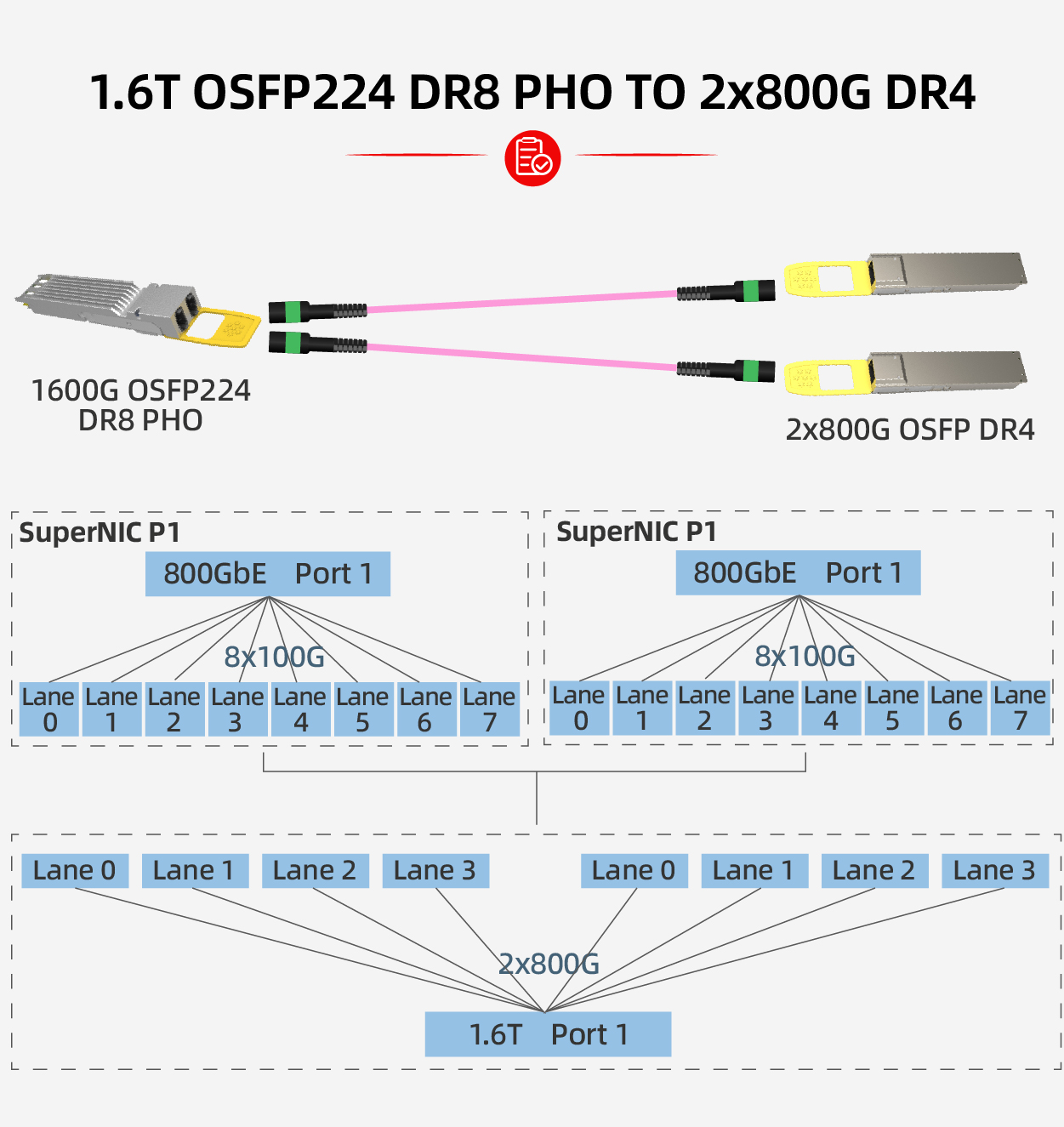
Leading AI companies have launched 1.6T OSFP switches and 800G OSFP RHS (Riding Heat Sink) server NICs, capable of achieving all-to-all GPU cluster interconnectivity through two-layer fat-tree network topologies.
1600G OSFP224 DR8 PHO: Product Introduction & Advantage Comparison