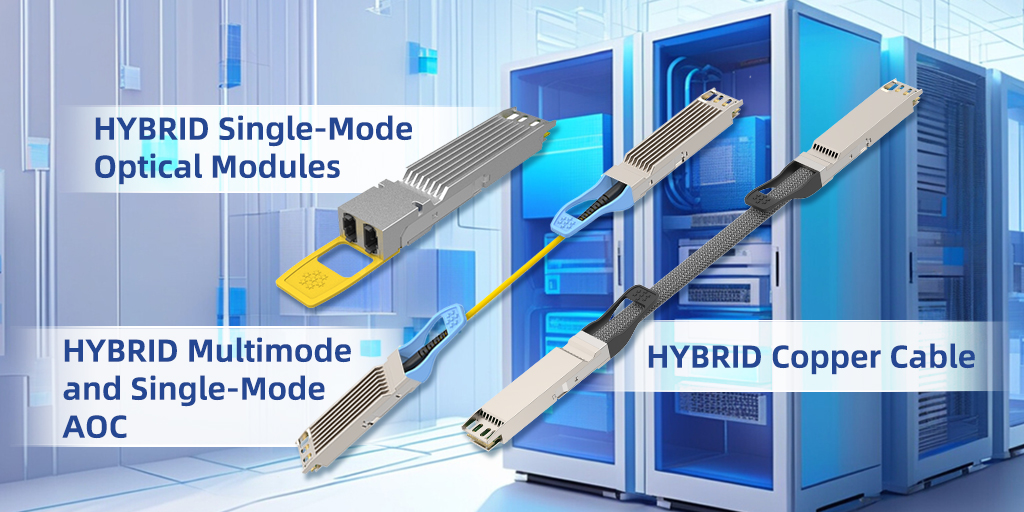









Products & Solutions
GIGALIGHT focuses on developing decoupled optical network modules and subsystems to reduce capital expenditure(CAPEX) and operating expenditure(OPEX) for data centers and telecom operators. Since its establishment, the company has actively cooperated with global operators to realize the interconnection of optical networks, and has been widely recognized as a veritable advocate and leader of open optical interconnection middleware.
AI & DC Interconnet
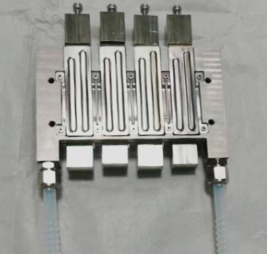
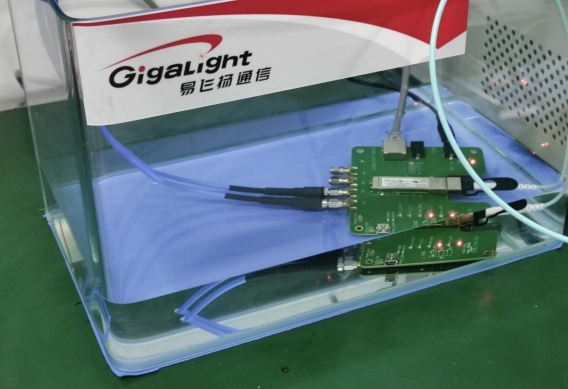
- Immersion Liquid Cooling
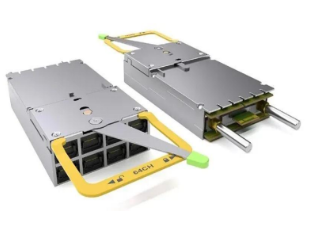
- Optical Transceivers(III-V & SiPh)
- High Speed Interconnect Cable
- CPO(Co-Packaged Optics)
NG Fixed Network & Mobile Network
- 5G Fronthaul Transceivers & HAOC
- Metro 100G/200G/400G Transceivers
- Low-speed SDH/OTN Transceivers
- MUX/DEMUX WDM Passive
Open DWDM Network
- Color X O-BAND Module & Subsystem
- Color ZR C-BAND Module & Subsystem
- Coherent Optical Module & DCI BOX
- Passive AAWG DWDM


Need Help?
If the customer service is not online, please leave us a message, we will arrange professional sales or technical personnel to contact you within 24 hours.
News & Events
Press Releases, Upcoming Events, Industry Insights and Marketing Reports
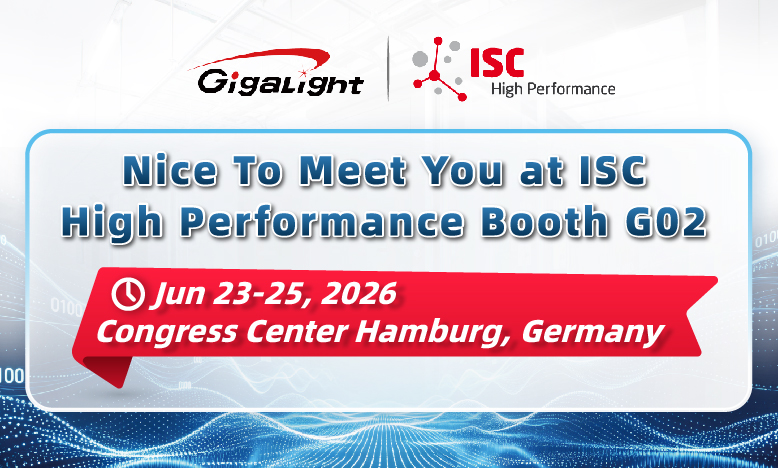
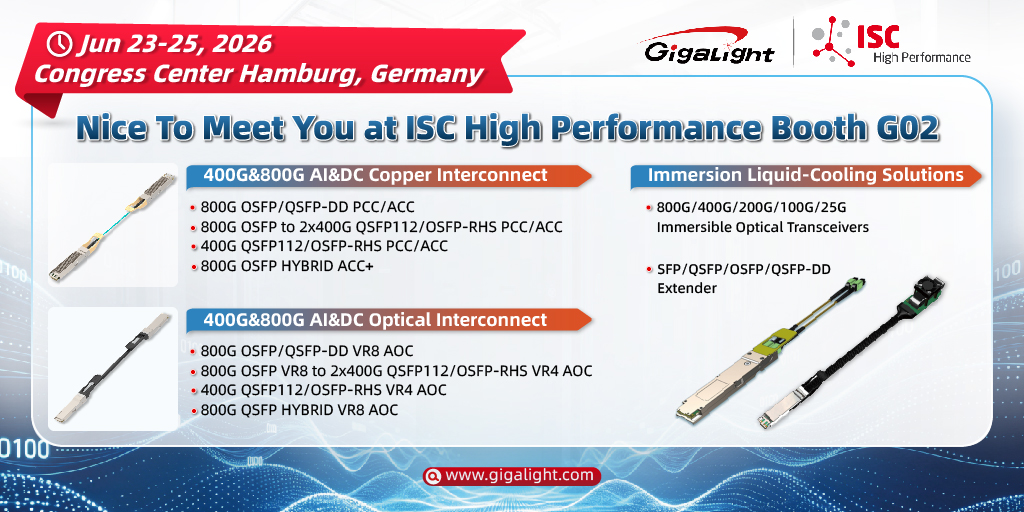
ISC High Performance 2026 – JUNE 22-26

ISC High Performance 2026
Date:JUNE 22-26
location:Congress Center Hamburg
Germany
The Parallel Evolution Logic and Industry Choices of HYBRID, LPO, LRO, and DSP— Why HYBRID Is More Practical Than LRO from a System Engineering Perspective
I. Introduction: Parallel Coexistence, Not a Battle of Routes
As AI and data center interconnects rapidly advance toward 800G and 1.6T, LPO, LRO, and traditional DSP-based optical modules are not engaged in a “winner-takes-all” replacement battle. Instead, constrained by different system requirements, transmission distances, and levels of industry maturity, they form a long-term pattern of parallel coexistence.
Within this parallel framework, HYBRID (semi-DSP) solutions—representing a more engineering-oriented intermediate architecture—are demonstrating clear advantages over typical LRO solutions in terms of overall system and industrial value.
Based on a systematic review of the parallel evolution logic of LPO, LRO, and DSP, and combined with real-world 800G HYBRID product implementations, this paper compares the strengths and weaknesses of each approach and focuses on a key question:
Why is HYBRID more practical and advantageous than LRO in real-world deployment?
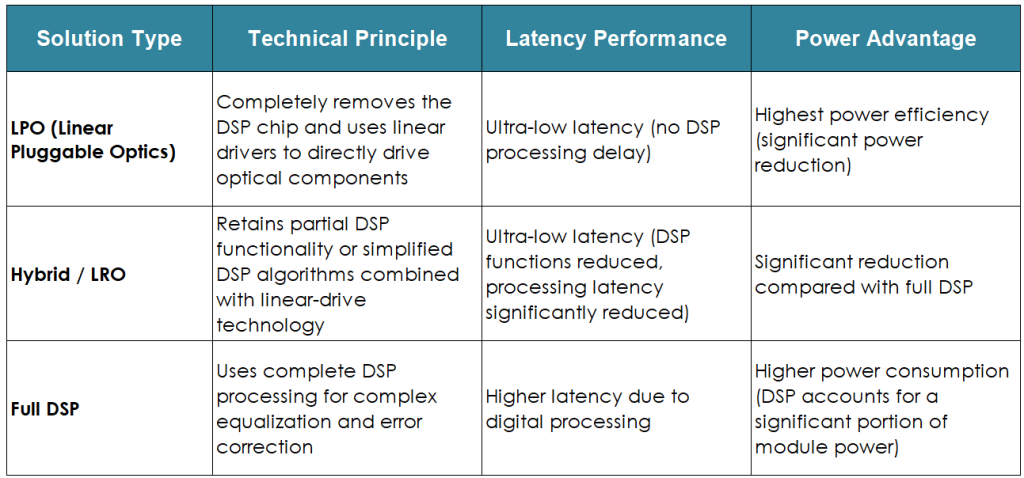
II. Review of the Three Fundamental Architectures: DSP, LPO, and LRO
1. DSP-Based Modules: The “Ballast Stone” of Performance and Ecosystem
(1)Architecture Characteristics:Full DSP on both TX and RX sides
(2)Advantages
- Strongest signal processing capability (equalization, CDR, FEC, nonlinear compensation)
- Supports medium, long, and ultra-long reach transmission
- Mature industry ecosystem, complete standards, true plug-and-play
(3)Disadvantages
- High power consumption (800G typically >14–16 W)
- Higher latency
- Highest cost
(4)Typical Applications
- Metro networks, backbone networks, DCI
- Mission-critical links with extreme reliability requirements

2. LPO: Ultimate Power Efficiency with the Deepest System Coupling
(1)Architecture Characteristics : No DSP inside the module . Signal processing fully shifted to the host SerDes
(2)Advantages
- Lowest power consumption (30–50% reduction compared to DSP)
- Ultra-low latency
- Lowest module BOM cost
(3)Disadvantages
- Extremely stringent requirements on host SerDes and channel consistency
- Limited transmission distance (typically ≤100m)
- Complex system tuning and immature ecosystem
(4)Typical Applications
Intra-rack and inter-rack ultra-short-reach interconnects in AI clusters

3. LRO: A Conceptual Compromise
(1)Architecture Characteristics : DSP retained on TX side,Linear RX architecture
(2)Advantages
- Lower power consumption than full DSP
- Better reach capability than LPO
(3)Practical Challenges
- Highly fragmented TX simplex DSP implementations
- Poor chip reusability and weak economies of scale
- Ecosystem has not reached mainstream adoption

III. HYBRID: A More Engineering-Mature “Semi-DSP” Path
1. The Essential Definition of HYBRID
HYBRID is not simply equivalent to LRO. Instead, it is a system-level DSP resource reallocation methodology:
HYBRID = Only half of the TX/RX paths inside the module pass through DSP, and for the module-level transmit/receive links, only TX or RX passes through DSP,while the remaining paths adopt linear architectures.
Conceptually, this can be understood as: HYBRID ≈ (LRO + LTO) / 2
Below is the patented HYBRID architecture description from GIGALIGHT:

HYBRID 800G Multimode Architecture Diagram (Patent Applied)

HYBRID 800G Single-Mode Architecture Diagram (Patent Applied)

HYBRID 800G Copper Cable Architecture Diagram (Patent Applied)
2. Key Differences: HYBRID vs. LRO
| Dimension | LRO | HYBRID |
| DSP Type | TX simplex DSP | Mature duplex DSP |
| Chip Reusability | Very low | High, reuse of existing DSP |
| Market Scale | Niche, customized | Scalable, mass-producible |
| Supply Chain Risk | High | Low |
| System Consistency | Medium, one-side linear | Medium, one-side linear |
Core Conclusion:
HYBRID does not introduce a new class of highly specialized DSP chips. Instead, it reuses mature duplex DSP architectures and simply reduces the number of active channels.
Furthermore, early system-level validation shows that certain LTO-based system links can even outperform LRO links, reinforcing HYBRID’s clear advantage over LRO in real industrial deployment.
IV. Comprehensive Advantages and Practical Challenges of HYBRID Key Advantages of HYBRID
1. Key Advantages of HYBRID
- Significant power reduction:~20–30% lower than full DSP solutions
- Ultra-low link latency:DSP count reduced by half; latency comparable to LRO
- Controllable signal quality:MMF 50m: PRE-FEC BER up to E-7 / E-8,SMF 500m: PRE-FEC BER up to E-10
- Clear cost optimization:~20% cost reduction versus traditional DSP solutions
- Support for higher channel density:Viable path toward 16-channel / 3.2T pluggable modules
2. Limitations and Challenges of HYBRID
- Non-DSP RX paths place slightly higher requirements on host SI tuning
- Requires system-level co-optimization rather than pure “plug-and-play”
- Still in early stages of large-scale deployment, requiring customer-side collaboration
However, compared with LPO and LRO, the engineering and deployment risks of HYBRID are significantly more controllable.
V. The Inevitability of Parallel Coexistence: Why There Is No Single Winning Route
| Scenario | Optimal Solution |
| ≤100m, ultra-low latency | LPO |
| 100m – 2km, power/performance balance | HYBRID / LRO |
| ≥2km, maximum reliability | DSP |
These three solutions address different system constraints and optimization targets, rather than forming a simple generational replacement relationship.
VI. Conclusion: HYBRID Is the Most Realistic Intermediate Solution
- LPO is an idealized extreme solution
- DSP is an irreplaceable foundational solution
- HYBRID is currently the most engineering-feasible intermediate solution
Compared with LRO, HYBRID’s decisive advantage lies in the fact that:
It does not rely on highly specialized TX simplex DSPs with extremely limited market demand, but instead reuses mature, scalable duplex DSP architectures.
This enables HYBRID to achieve clear overall competitiveness in power consumption, cost, ecosystem maturity, supply chain stability, and system-level deployment.
In the foreseeable future, LPO, HYBRID, and DSP will continue to coexist, jointly forming the technological foundation of AI and data center interconnects.
About GIGALIGHT
As an open optical networking explorer, GIGALIGHT integrates the design, manufacturing, and sales of both active and passive optical devices and subsystems. The company’s product portfolio includes optical modules, silicon photonics modules, liquid-cooled modules, passive optical components, active optical cables, direct attach copper cables, coherent optical communication modules, and OPEN DCI BOX subsystems. GIGALIGHT focuses on serving applications such as data centers, 5G transport networks, metropolitan WDM transmission, ultra-HD broadcast and video, and more. It stands as an innovative designer of high-speed optical interconnect hardware solutions.
0 3GIGALIGHT Launches 800G HYBRID Green Optical Interconnect Products, Driving Category Innovation for AI & DC Interconnects
December 26, 2025, Shenzhen, China. – Driven by design innovation, GIGALIGHT today officially announced the launch of its 800G OSFP HYBRID AI & DC optical interconnect product portfolio.
The new portfolio includes:
800G OSFP-PHO DR8 / 2×DR4 heterogeneous optical modules
800G OSFP HYBRID PSM8-AOC active optical cables
800G OSFP-PHO VR8 / 2×VR4 heterogeneous optical modules
800G OSFP HYBRID VR8-AOC active optical cables
Unlike traditional full-DSP optical modules (DPO), the HYBRID architecture adopts DSP on only half of the channels, significantly reducing power consumption and latency.
HYBRID optical modules and active optical cables draw on the widely adopted LPO / LRO design methodologies in the industry. However, from the perspective of strict system-level signal alignment, HYBRID introduces a more advanced and balanced design strategy.
The HYBRID design philosophy can be simply expressed as:HYBRID = (LTO + LRO) / 2
Notes:
LRO: DSP on TX side with linear RX
LPO: Fully linear, DSP-less design
LTO: DSP on RX side with linear TX
1. HYBRID 800G Multimode PHO Modules & AOC Reference Design— Up to 30% Power Saving vs. Traditional DPO

HYBRID 800G Multimode Architecture Diagram (Patent Applied)
HYBRID 800G Multimode Product Portfolio:
(1) 800G OSFP-PHO VR8, 50 m, Dual MPO-12/APC—Max power consumption < 9 W,~30% lower power compared to existing DSP solutions;
(2) 800G OSFP-PHO 2×VR4, 50 m (Under development)—Supports 2×400G VR4 heterogeneous system interconnects;
(3) 800G OSFP HYBRID VR8-AOC, 50 m

2. HYBRID 800G Heterogeneous Silicon Photonics Modules & AOC Design—~22% Power Saving

HYBRID 800G Single-Mode Architecture Diagram (Patent Applied)
HYBRID 800G Single-Mode Product Portfolio:
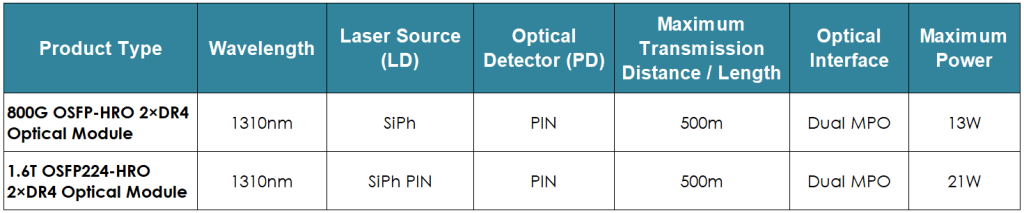
(1) 800G OSFP-PHO DR8, 500 m, Dual MPO-12/APC(Optional MPO-16/APC)—Max power consumption < 12 W,
~22% lower power vs. traditional DSP solutions;
(2) 800G OSFP-PHO 2×DR4, 500 m (Under development)—Supports 2×400G DR4 heterogeneous system interconnects;
(3) 800G OSFP HYBRID PSM8-AOC, 500 m

Q1: What Are the Advantages and Disadvantages of HYBRID?
Key Advantages:
- Lower Power Consumption : ~20%–30% power reduction compared with full-DSP solutions, effectively easing thermal and energy challenges in high-density port deployments.
- Ultra-Low Latency : ~50% latency reduction versus traditional DSP architectures, making it ideal for latency-sensitive AI computing and high-speed interconnects.
- Excellent Signal Quality : Multimode OM4 @ 50 m: Pre-FEC BER of E-7 / E-8,Single-mode @ 500 m: Pre-FEC BER of E-9 / E-10,Ensures robust and stable system operation.
- Significant Cost Optimization : ~21% total cost reduction compared with conventional DSP solutions.
- Reference Value for DSP Vendors : Provides new architectural insights for next-generation DSP optimization.
Challenges and Limitations
- Non-DSP RX Requirements : In LRO-like architectures, the host system must perform signal integrity parameter matching.In long-term loopback testing, blind tuning shows symbol error counts <10, indicating room for further system-side optimization.
- Early-Stage Adoption : Commercial large-scale deployment is still in its early phase and requires ecosystem and customer support.
Q2: Why Is HYBRID Needed?
HYBRID optical modules and active optical cables leverage mature LPO / LRO architectures, while introducing more advanced system-level signal alignment strategies.
By applying DSP to only half of the channels, HYBRID achieves:
Lower power consumption
Reduced latency
Lower overall cost
The HYBRID design methodology enables the feasibility of 16-channel / 3.2T pluggable optical modules, paving the way for next-generation ultra-high-speed interconnects.
Q3: What AI & DC Interconnect Products Does HYBRID Support?
HYBRID supports:
Multimode VCSEL platforms
Single-mode silicon photonics platforms
Active copper + optical (ACC+) platforms
The HYBRID architecture can also support PCIe over optics applications.
Product Status & Roadmap
As of this announcement, GIGALIGHT has completed the design of:
400G QSFP-DD HYBRID VR8
800G OSFP HYBRID VR8 / DR8 optical modules and AOCs
Samples are available for customer evaluation.The 1.6T OSFP224 HYBRID 2×DR4 silicon photonics module is currently under development and is scheduled for mass availability in Q2 2026.
GIGALIGHT looks forward to working closely with industry partners and customers to jointly accelerate the large-scale adoption and value realization of the HYBRID design methodology in next-generation AI and data center networks.
About GIGALIGHT
As an open optical networking explorer, GIGALIGHT integrates the design, manufacturing, and sales of both active and passive optical devices and subsystems. The company’s product portfolio includes optical modules, silicon photonics modules, liquid-cooled modules, passive optical components, active optical cables, direct attach copper cables, coherent optical communication modules, and OPEN DCI BOX subsystems. GIGALIGHT focuses on serving applications such as data centers, 5G transport networks, metropolitan WDM transmission, ultra-HD broadcast and video, and more. It stands as an innovative designer of high-speed optical interconnect hardware solutions.
0 41.6T Heterogeneous Interconnect Solution – 1.6T OSFP224 DR8 PHO to 2×800G DR4 heterogeneous interconnection
Overview
GIGALIGHT’s 1.6T OSFP224 DR8 PHO silicon photonics module employs the company’s patented Hybrid architecture technology, which can be implemented using either VCSEL-based or silicon photonics-based designs. Unlike traditional full-DSP optical modules, the HYBRID design uses only half of the DSP channels, resulting in significantly reduced power consumption and latency.
The HYBRID modules and active optical cables draw inspiration from industry-standard LPO/LRO design methodologies, but from a system-level signal alignment perspective, the HYBRID approach provides a more advanced design strategy. Conceptually, the HYBRID design can be expressed as: HYBRID = (LTO + LRO) / 2
The primary goal of this technology is to deliver a new, optimized path for 800G AI & Data Center interconnects, as well as 1.6T and higher-speed AI & DC systems, offering clear advantages in power efficiency, latency, and cost.

Technical Highlights
- AI/ML-Driven: Meeting the surge in AI computing, networks are moving into the 1.6T era.
- Key Breakthrough: Overcoming power and efficiency challenges in 1.6T/800G heterogeneous networks, particularly those caused by branch interconnects and gearbox operations.
- Objective: Enabling the development of more efficient, cost-effective AI/ML hyperscale data centers.
Application Scenarios

Leading AI companies have launched 1.6T OSFP switches and 800G OSFP RHS (Riding Heat Sink) server NICs, capable of achieving all-to-all GPU cluster interconnectivity through two-layer fat-tree network topologies.
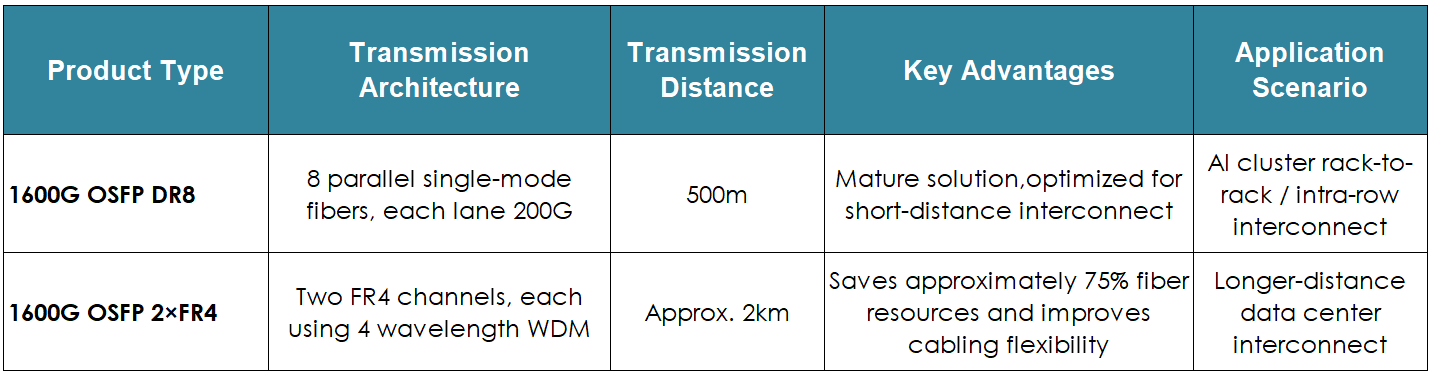
1600G OSFP224 DR8 PHO: Product Introduction & Advantage Comparison

1.6T CPO DR16 Silicon Photonics Engine Solution– Enabling a new ecosystem for CPO-based switches
Overview
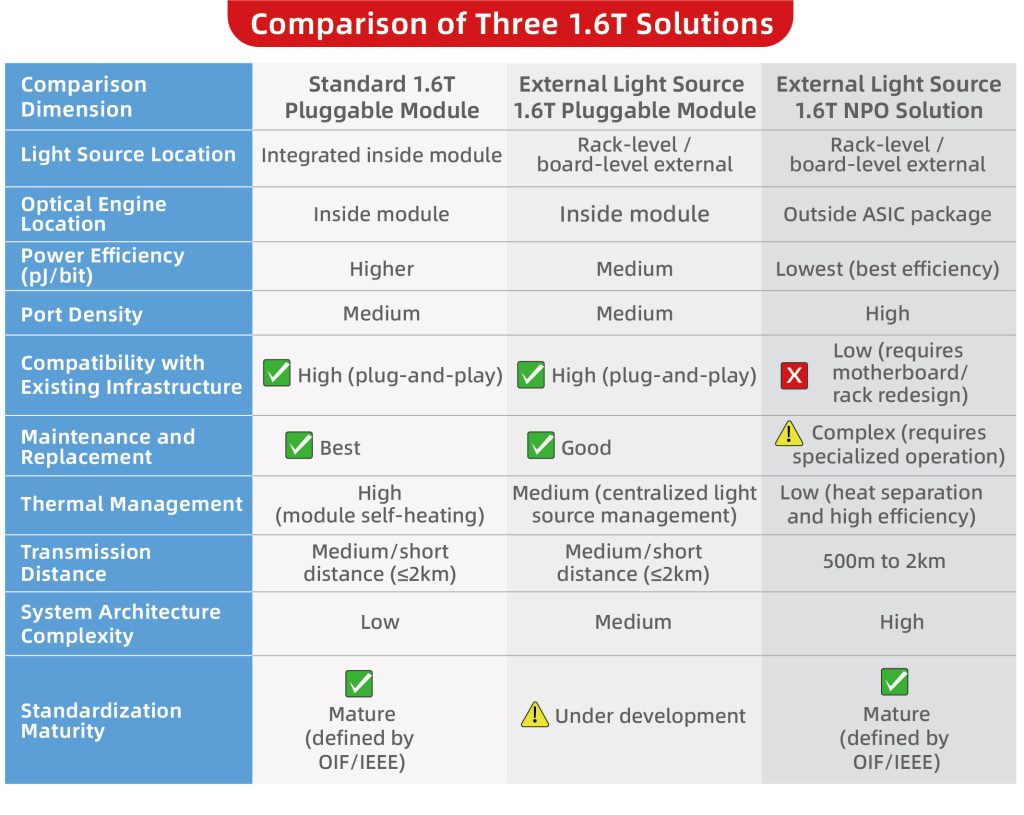
The 1600G CPO DR16 Silicon Photonics Engine, based on linear direct-drive technology, is part of GIGALIGHT’s portfolio of innovative products for the next-generation optical network era. The 1600G linear CPO combines a SOCKET-type package with LPO linear direct-drive technology.
Compared with traditional NPO/CPO designs, the linear CPO silicon photonics engine eliminates the DSP, resulting in significantly lower system-level power consumption and reduced overall costs.

Key Products & Highlights
1.6T DR16 CPO Silicon Photonics Engine
- 16x100G PAM4
- Up to 500m transmission
- Power comsuption<16W
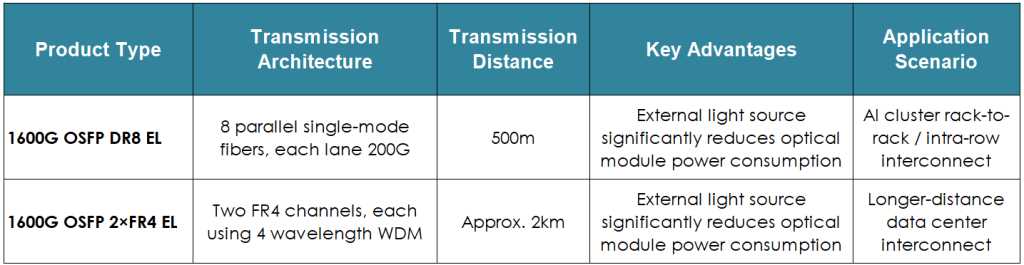
EL-OSFP External Light Source Module
- Front-facing optical port design
- Supports 16-channel CWL high-power light sources
Application Scenarios

Hybrid Architecture Equivalent Active Optical Cable Solutions– 400G / 800G / 1.6T OSFP224
Overview
GIGALIGHT’s 400G, 800G, and 1.6T OSFP224 Hybrid Architecture Equivalent Active Optical Cable (Hybrid AOC) products utilize GIGALIGHT’s patented Hybrid AOC technology, which can be implemented using either VCSEL-based or silicon photonics-based designs.
Unlike traditional full-DSP optical modules, the HYBRID architecture employs DSP on only half of the channels, resulting in significantly reduced power consumption and latency. While HYBRID modules and AOCs draw on standard industry LPO/LRO design approaches, they provide a more advanced strategy for precise system-level signal alignment. The HYBRID design methodology can be conceptually represented by the formula: HYBRID = (LTO + LRO) / 2
This patented approach is designed to enable a new paradigm for AI & DC interconnects at 800G and above 1.6T, focusing on reducing power consumption, latency, and cost.

Key Product Highlights
- Transmission up to 30m/OM3 and 50m/OM4 MMF, up to 500m SMF
- Comprehensively superior to traditional DSP solutions
GIGALIGHT Hybrid Architecture Equivalent AOC Portfolio
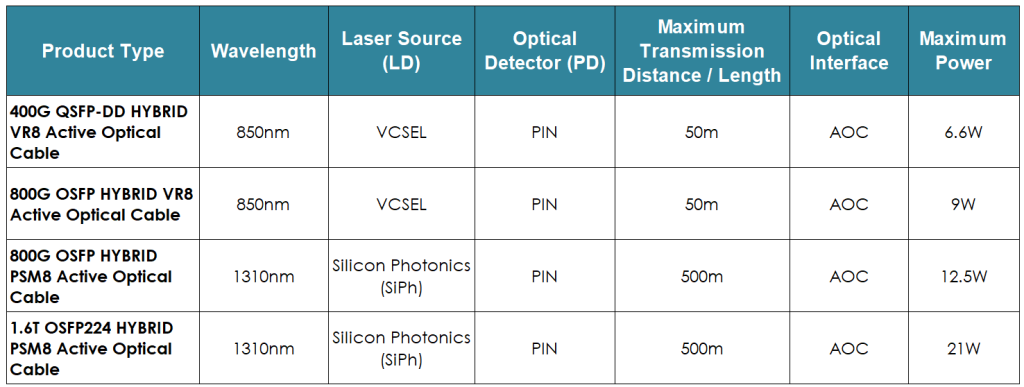
| No. | Name | Power Consumption |
|---|---|---|
| 1 | 400G QSFP-DD HYBRID VR8-AOC | 6.6W |
| 2 | 800G OSFP HYBRID VR8-AOC | 9W |
| 3 | 800G OSFP HYBRID PSM8-AOC-SiPh | 12.5W |
| 4 | 1.6T OSFP224 HYBRID PSM8-AOC-SiPh | 20W |
Application Scenarios

800G OSFP / 800G QSFP-DD & 1.6T OSFP224 Hybrid ACC+ Copper Cable Solutions
Overview
GIGALIGHT’s 800G OSFP / 800G QSFP-DD and 1.6T OSFP224 Hybrid ACC+ copper cable products leverage a key patented technology for AI & DC interconnect systems: the Hybrid Architecture Equivalent Active Copper Cable (Hybrid ACC+).
This patent combines the advantages of existing PCC/ACC and AEC technologies and is redesigned at the system interconnect level. The design goal is to achieve 50% reductions in power consumption, latency, and cost compared with conventional AEC cables, while delivering a transmission reach close to 80% of the optimal AEC cable distance.

Key Product Highlights
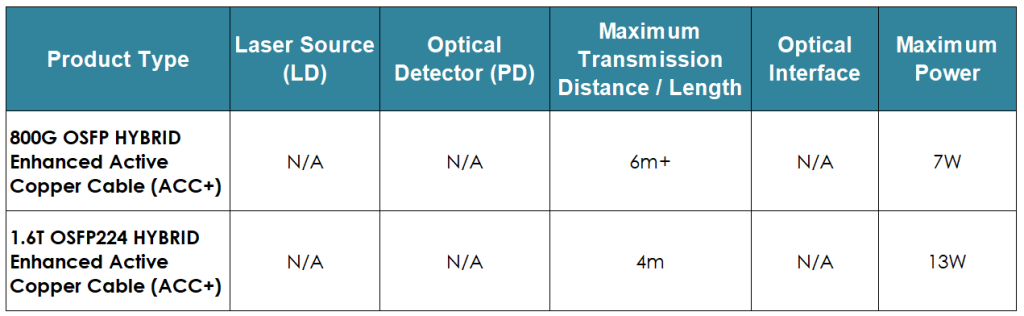
- Transmission up to 5m
- Only 4-channel DSP per end
- Pre-FEC BER better than 1E-8
- Comprehensive breakthrough of traditional AEC and ACC solutions
GIGALIGHT Hybrid Architecture Equivalent ACC Portfolio
| No. | Name | Power Consumption |
|---|---|---|
| 1 | 800G OSFP HYBRID ACC+ | 7W |

| 2 | 800G QSFP-DD HYBRID ACC+ | 7W |
| 3 | 1.6T OSFP224 HYBRID ACC+ | 13W |
Application Scenarios

AI & DC 800G Hybrid Optical Interconnect Solution– Hybrid 800G VR8-AOC and DR8 PHO replacing traditional 800G AOC and 800G DR8
Overview
The 800G OSFP HYBRID VR8-AOC replaces traditional 800G OSFP AOCs, while the 800G OSFP DR8 PHO silicon photonics module serves as a substitute for conventional 800G OSFP DR8 modules. Unlike traditional full-DSP optical modules, the HYBRID architecture uses DSP on only half of the channels, resulting in significantly reduced power consumption and latency.
While HYBRID modules and active optical cables draw on standard industry LPO/LRO design approaches, they offer a more advanced strategy for precise system-level signal alignment. The HYBRID design methodology can be conceptually represented by the formula: HYBRID = (LTO + LRO) / 2
This solution delivers high compatibility, low insertion loss, and flexible deployment, making it ideal for high-density, cost-efficient AI data center interconnects, achieving an optimal balance of transmission performance and cost efficiency.

Key Products & Highlights
800G OSFP HYBRID VR8-AOC – Next-Generation Replacement for Traditional 800G OSFP AOC
- Ultra-Low Power Consumption: <9 W, achieving approximately 20%–25% lower power than conventional DSP solutions.
- Extended Reach: Supports up to 30 m on OM3 and up to 50 m on OM4 (with KP4-FEC enabled).
- Reduced Link Latency: Link latency is reduced by nearly 50% compared with traditional DSP solutions.
- Superior Signal Quality: Designed to achieve pre-FEC BER of E-7/E-8, ensuring reliable high-speed transmission.
800G OSFP DR8 PHO (Pluggable Hybrid Optics) SiPh Module – Advanced Replacement for Traditional 800G OSFP DR8
- Ultra-Low Power Consumption: <13 W, achieving approximately 20% lower power than conventional DSP solutions.
- Extended Reach: Supports up to 500 m on single-mode fiber (SMF) with KP4-FEC enabled.
- Reduced Link Latency: Link latency reduced by nearly 50% compared with traditional DSP solutions.
- Superior Signal Quality: Designed to achieve pre-FEC BER of E-7/E-8, ensuring reliable high-speed transmission.
Application Scenarios

Next-Generation Hybrid Optical Interconnect for 400G Data Centers– 400G QSFP-DD Hybrid VR8-AOC replacing traditional 400G QSFP-DD VR8 AOC
Overview
The 400G QSFP-DD HYBRID VR8-AOC leverages GIGALIGHT’s patented Hybrid Active Optical Cable (Hybrid AOC) technology. Unlike traditional full-DSP optical modules, the HYBRID architecture employs DSP on only half of the channels, significantly reducing power consumption and latency.
While the HYBRID modules and AOCs draw inspiration from industry-standard LPO/LRO design approaches, they offer a more advanced strategy for precise system-level signal alignment. The HYBRID design methodology can be conceptually represented by the formula: HYBRID = (LTO + LRO) / 2
By applying hybrid interconnect technology, the 400G QSFP-DD VR8 AOC provides a next-generation upgrade to conventional solutions, delivering low insertion loss, high compatibility, and flexible deployment. It is optimized for high-density, cost-efficient data center interconnects, achieving superior transmission performance and operational efficiency.

Technical Highlights
- Ultra-Low Power Consumption: 6.6W, achieving a 20%–25% reduction compared with traditional 400G QSFP-DD AOC (<10W).
- Significant Cost Optimization: Approximately 21% lower overall cost compared to conventional DSP solutions.
- Extended Reach: Supports transmission up to 30 m over OM3 and 50 m over OM4 multimode fiber.
- Ultra-Low Link Latency: Link latency reduced by nearly 50% versus traditional DSP solutions.
- Superior Signal Quality: Designed to achieve pre-FEC BER of E-7/E-8 on OM4 50 m links.
Application Scenarios