
GIGALIGHT Hybrid Technology Enables 1.6T AI Interconnect Architecture to Break Free from Liquid Cooling Dependency — ECOC 2026 Demonstration
September 14, 2026, Shenzhen, China. – As AI training clusters scale to 100,000 GPUs and beyond, 1.6T high-speed optical transceivers are becoming a critical hardware component for data center interconnects (DCI) between racks. Mainstream 1.6T transceivers based on full-DSP architectures typically consume 25–28W. In high-density OSFP switch racks, this level of power consumption exceeds the practical thermal capacity of conventional air cooling, making liquid-cooling upgrades increasingly necessary for large-scale deployment.
Liquid cooling not only requires significant capital investment in servers, racks, piping, and monitoring systems, but also involves data center infrastructure upgrades and major changes to operation and maintenance processes. This substantially increases the deployment threshold and Total Cost of Ownership (TCO) for AI computing expansion.
Numerical Basis
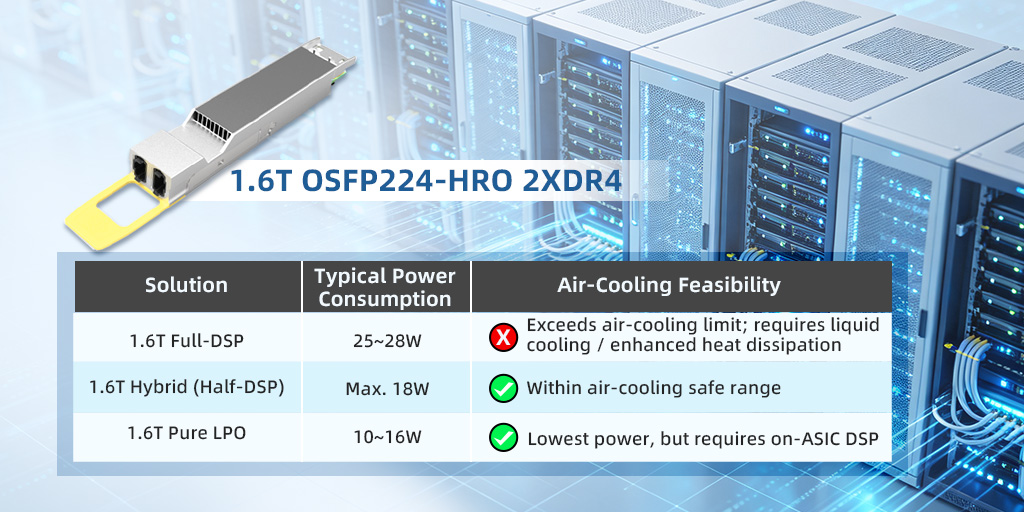
1. Air-cooling limit: approximately 25W
For conventional pluggable OSFP optical transceivers, thermal capacity is constrained by rack airflow, inlet/outlet temperatures, and the high-density deployment of 8×200G channels. In practical high-density rack environments, the power capacity of air cooling is typically around 25W.
2. Full-DSP architectures exceed the limit: 25–28W
Power consumption above the practical air-cooling limit requires liquid cooling or enhanced thermal management in high-density racks. This is also one of the reasons why platforms such as NVIDIA GB200 have adopted liquid cooling as a standard solution.
3. Hybrid architecture leaves sufficient thermal headroom: 18W
With a maximum power consumption of only 18W, the Hybrid solution operates more than 7W below the typical air-cooling limit. It can therefore be deployed directly in existing air-cooled switch racks. This provides significant value for customers upgrading existing data center infrastructure and for AI computing customers who prefer to avoid liquid-cooling deployment.
4. Pure LPO offers lower power consumption, but with architectural trade-offs: 10–16W
Pure LPO solutions offer the lowest power consumption, but require next-generation switch ASICs with built-in DSP capabilities. As a result, they cannot provide the same plug-and-play compatibility with existing switch platforms.
As the inventor of Hybrid technology, GIGALIGHT will demonstrate at ECOC 2026 in Europe a key technology option designed to eliminate the need for mandatory liquid cooling in 1.6T interconnect deployments: the 1.6T OSFP224-HRO 2×DR4 heterogeneous silicon photonics transceiver, featuring a maximum power consumption of only 18W.
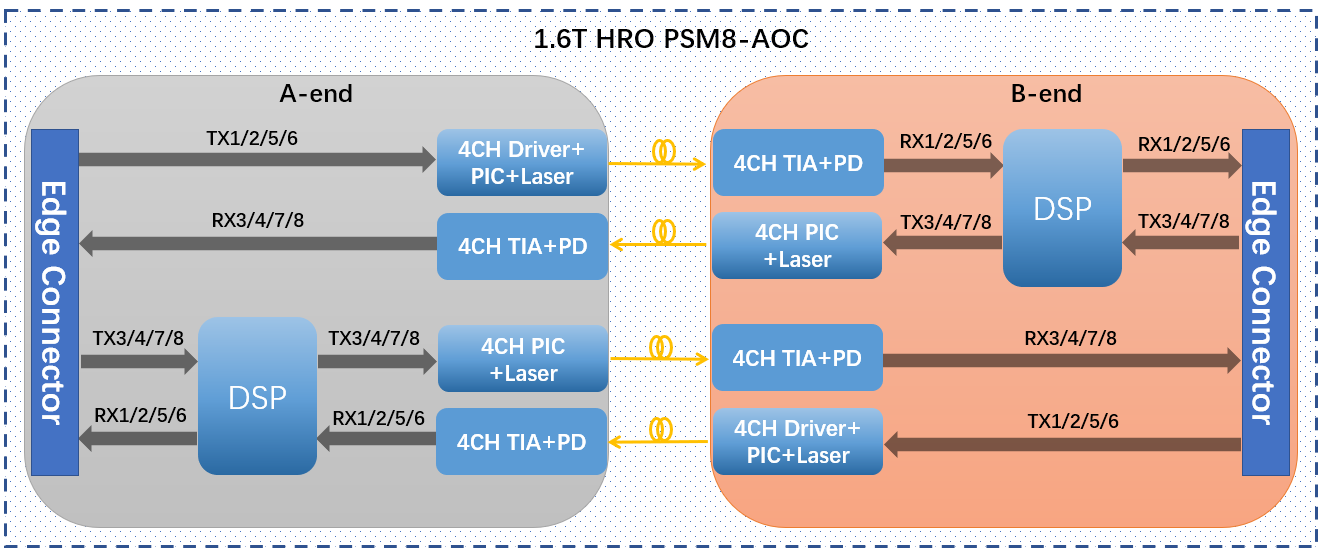
1.6T Hybrid Architecture Diagram
Key Product Advantages
1. Exceptional Energy Efficiency with Significantly Reduced Power Consumption
The transceiver features a maximum operating power consumption of only 18W across the full operating range. Compared with mainstream 3nm full-DSP solutions with equivalent specifications, power consumption is reduced by approximately 28%–35%. This significantly alleviates thermal pressure in high-density racks while reducing long-term power consumption and O&M TCO in AI and HPC data centers.
2. Robust Transmission Across the Full Operating Range with BER Performance Beyond Protocol Requirements
Across the full operating temperature range, the BER performance of all eight channels exceeds the requirements defined by the 1.6T OSFP-DR8 international protocol specification. The solution provides enhanced stability for high-speed, long-reach transmission and can reliably support 500-meter short- and medium-distance interconnects in AI clusters.
3. Proprietary Cross-Channel Coordination Mechanism Addresses Key Limitations of Pure LPO Architectures
The product retains DSP-based signal-processing capabilities for critical channels and supports cross-channel signal enhancement, clock calibration, and phase synchronization. It enables real-time error correction and timing optimization for linear LPO links, addressing key industry challenges associated with pure linear architectures, including link instability, limited self-diagnostic capabilities, and difficult network adaptation.
This approach combines low power consumption with practical commercial deployability.
“Many AI computing customers are currently facing a difficult choice: deploying full-DSP 1.6T solutions requires costly liquid-cooling upgrades, while adopting LPO/NPO architectures requires a fundamental redesign of the system hardware. The core value of the Hybrid heterogeneous architecture is to break this dilemma.”
“By retaining a portion of DSP capabilities inside the transceiver, we can keep power consumption within the range supported by conventional air cooling while protecting customers’ existing data center investments. This provides a practical path for smoothly upgrading existing AI computing clusters to 1.6T interconnects.”
— GIGALIGHT Technical Lead
About GIGALIGHT
As an open optical networking explorer, GIGALIGHT integrates the design, manufacturing, and sales of both active and passive optical devices and subsystems. The company’s product portfolio includes III-V optical modules, silicon photonics modules and silicon-based NPO/CPO engines, liquid-cooled optical modules, passive optical components, Active Optical Cables (AOCs), Direct Attach Cables (DACs), coherent optical communication modules, OPEN DCI BOX subsystems based on coherent and O-band DWDM optical modules, and UHD SDI video optical transceivers. GIGALIGHT focuses on applications including AI data centers, 5G transport networks, metropolitan WDM transmission, and ultra-HD broadcast and video, positioning itself as an innovative designer of high-speed optical interconnect hardware solutions.